Dear Fellow artists, creators, and Kalaa students. In a world that seems to spin faster every day—where digital tools can conjure images in seconds and AI attempts to mimic human expression—you have chosen a deliberate, time-honored path. You are learning the fine arts with the hand.
Perhaps you have asked yourself, “Is this relevant? Am I spending too much time learning to draw from a model when I could be learning to prompt?”
The answer, more than ever, is yes. The authentic practice of fine art is not just relevant; it is the cornerstone of creative mastery. Mastering the traditional disciplines is not about rejecting technology, but about building a core creative instinct that makes everything you create better. Here is why your path is the ultimate edge, and how you can master your creativity through it.
We are living in a fascinating time, a “Tradigital Renaissance.” The pendulum is swinging back. While digital art as shown in image is essential for rapid commercial work, there is a profound resurgence in demand for the physical, the authentic, and the “human hand.”
1. Fine Art Forces Real Problem-Solving
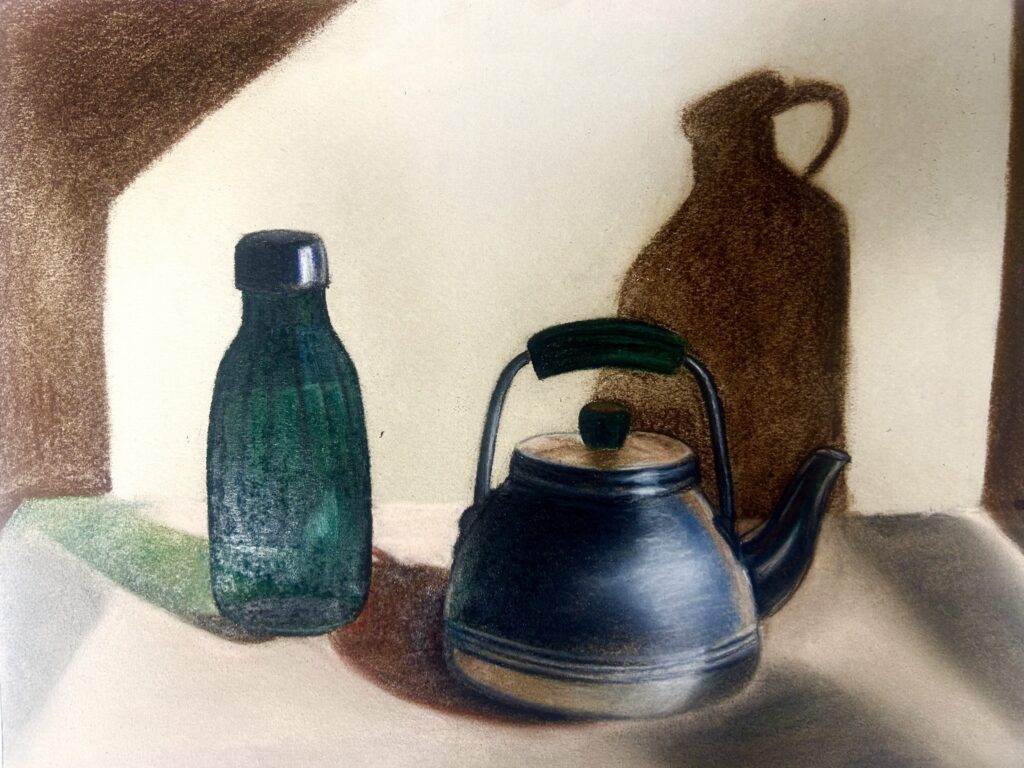
When you work with charcoal on paper or oil paint on a canvas (image_0.png), there is no “Ctrl+Z.” A mistake is not an error to be deleted; it is a problem that must be resolved. You have to paint over it, work it into the composition, or scrape it off and start again. This forces you to think three moves ahead. It develops resilience and improvisational creativity—muscles that digital artists often let atrophy. When you learn to pivot in the physical world, your problem-solving in any medium becomes effortless.
2. The Return of Texture and Humanity
Look closely at the surface of an impasto painting. The brushstrokes catch the light; the texture tells the story of the artist’s physical motion. This “imperfect perfection” is what people crave in 2026. After years of ultra-smooth, perfectly anti-aliased digital renders, human connection is found in the visible hand of the maker. Authentic fine art has a soul that technology can only try to imitate.
3. Building the Mind-Body Creative Conduit
When you draw, you are engaging your eyes, your mind, your hand, and your core. This full-body sensory engagement stimulates creative centers in the brain that a smooth screen cannot. You learn the texture of the charcoal, the drag of the brush, the physical resistance of the materials. This process builds what we call “creative stamina”—the ability to sit with an idea, work it through, and build it from the ground up, rather than just summoning it.
The Path to Mastery: How “Kalaa” Students Can Build Their Edge
As you learn fine art, you are not just making pretty pictures. You are training your mind. Here is how you master that creativity and translate it into a modern career or powerful personal expression:
Step 1: Deep Dive into the Fundamentals
You cannot effectively break the rules until you have mastered them.
- Anatomy: Don’t just copy a figure; understand the bones and muscles beneath. This is the foundation of character design.
- Value and Light: Master the ability to create form with only black and white. If you can make an object look three-dimensional with pencil, you can do it in any software.
- Color Theory: Learn how paint pigments actually mix, rather than relying on a digital color wheel. Understand the warmth and coolness that lives within a color.
Step 2: Bridge the Gap: Become “Tradigital”
Mastery of fine art does not mean avoiding digital art. In 2026, the most successful creators use both. Your authentic fine art training is your foundation; digital art is your amplifier.
- Spend time developing the physical skill, the patience, and the visceral feel of the material.
- When you need speed, scalability, and infinite iteration (like designing assets for a game, or testing color palettes), take your traditional understanding and apply it to the digital canvas.
- A traditionally trained digital artist produces work with depth and soul that is easily distinguished.

Digital Art
Step 3: Embrace the “Imperfect”
Creativity thrives on chaos. Don’t seek perfection. Fine art or Fashion Designing teaches you that a loose, expressive sketch can convey more emotion than a tightly polished render. Trust the process and lean into the accidental mark. It’s where the magic lives.
Conclusion
You are building something powerful. When you master drawing and painting by hand, you are not learning an obsolete skill. You are training the engine of your creative mind. You are building a reservoir of patience, discipline, and understanding that you can draw from for the rest of your life.
Technology will always change. Software will update. AI will evolve. But the fundamental understanding of how to observe the world, interpret it through your own unique filter, and translate it with your own hands—that is a creative mastery that will never become obsolete.
Keep painting. Keep drawing. Keep creating with your hands.
Your future self will thank you!
Dr. Nidhi Sharda